
CIO
For CIOs: keep control of a growing AI portfolio
From shadow AI to monitoring after go-live. 5 articles, about 40 minutes.
Start the routeArticles for leaders who have to choose which AI initiatives to fund, how to make them work and how to stay compliant. Every article draws on the MetroMinds Library of 4,980 AI use cases.
Four short series, each written for one role. Read them in order, or pick the article you need.
Start here
CIO
From shadow AI to monitoring after go-live. 5 articles, about 40 minutes.
Start the routeCFO
How to count savings once and turn saved time into money. 5 articles, about 40 minutes.
Start the routeCOO
Exceptions, scheduling, maintenance and the operations portfolio. 5 articles, about 40 minutes.
Start the routeCHRO
What changes in roles, which skills matter and who signs the decision. 4 articles, about 30 minutes.
Start the route
An AI register shows what you have. The EU AI Act deployer obligations are about how you run it: oversight, logs, monitoring, impact assessments and informing people.

You cannot classify or govern AI you have not found. One in fifteen Library use cases touches a high-risk area, and most of them sit outside HR and IT.

In 96 percent of AI use cases the AI prepares and a person decides. That makes the human in the loop a role that HR has to design, staff and support.

Most AI training plans start with prompts. The MetroMinds Library shows that people mainly need judgement: checking sources, applying policy and recording decisions.

Case and exception handling is the largest capability in the MetroMinds Library. Why AI can reach exception work early, and what the business case really covers.

Half of the 4,980 use cases in the MetroMinds Library change operational work. What that means for the COO, and why operational AI needs operational ownership.

Half of all AI benefits are priced as saved time. Library data shows why that time rarely reaches the cost line, and how CFOs can make sure it does.

Finance approves everyone else's AI business cases. The Library shows why its own work in tax, audit and planning is one of the easier places to start.

Half of all AI use cases concern operations and supply chain. What that means for AI portfolio management, and why the CIO's role grows with it.

Go-live is where AI risk changes shape. Library data shows which kinds of AI are hardest to observe, and what a practical monitoring routine looks like.

Risk teams talk about losses avoided, CFOs want a line that moves. Library data shows how banking AI benefits are priced and how to build a case both accept.

AI agents fit banking work well, but most are harder to put into production than they look. What the MetroMinds Library shows about readiness, latitude and control.

AI in banking compliance mostly saves time on preparing decisions, not making them. Library data on 18 use cases shows where the payoff is largest.

Storm peaks are now part of every claims year. What the Library shows about AI for claims surges, and how much extra capacity you can realistically expect.

In underwriting and pricing, the model is only part of the decision. What the Library shows about risk decisions, and what to put in place before go-live.

Claims attracts more AI ideas than any other part of insurance. How to compare them on value and feasibility, and pick the few worth funding first.

In all 29 manufacturing scheduling use cases in the MetroMinds Library, the planner keeps the final decision. What changes is how the planner spends the morning.

In every manufacturing sector, 38 to 41 percent of AI use cases are hard to deliver, mostly because of the decisions they support rather than the data.

Quality is the largest AI cluster in manufacturing, yet only 8 percent of those use cases are perception AI such as computer vision. The value sits in the work after the defect.

Route optimisation AI scores the highest possible value and some of the lowest feasibility in the MetroMinds Library. The reason sits in planning data that no system holds.

Most AI business cases turn saved time into lower costs. In government that rarely works. Here is how to show value through backlog, deadlines and quality instead.

The model is rarely the problem. Almost half of maintenance AI ideas are hard to deliver at scale because of what has to happen between the alert and the repair.

One in five AI use cases starts from documents, across every business function. Here is why document AI gets bought again and again, and how to build it once.

Agentic AI promises the same value as other AI but is harder to deliver and riskier. Four questions, based on 600 agentic use cases, tell you when an agent is worth it.
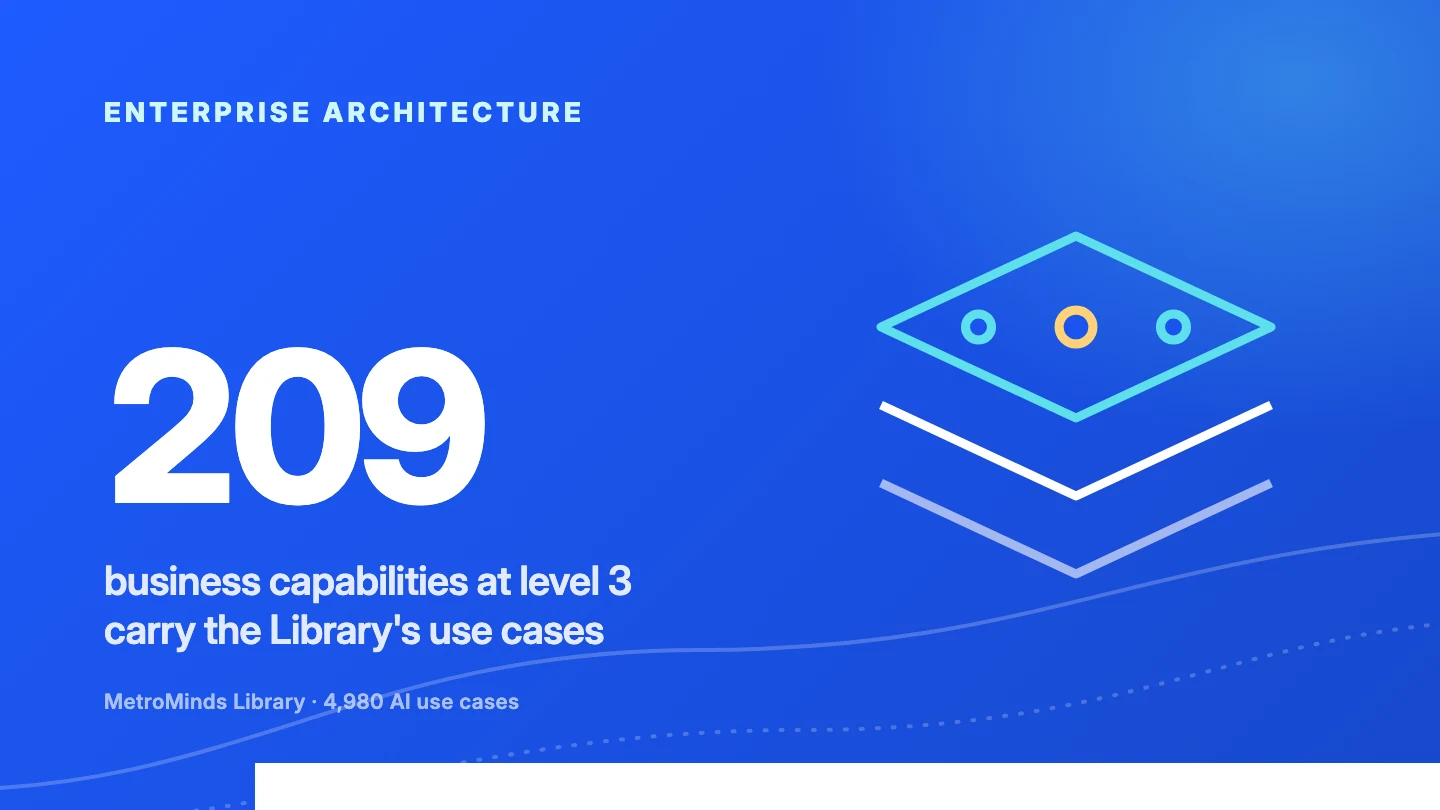
AI ideas cluster on a small part of the capability map. When architecture joins too late, organisations pay for the same integrations and data several times.

Only 4 percent of AI use cases sit in HR's own domain, yet nearly all of them change somebody's job. Here is how HR can get involved before the decisions are made.

The use cases with the highest value are often the hardest to deliver. Library data shows why the largest AI business case deserves the most scrutiny.

Nearly every AI use case promises time savings. When several target the same work, the totals stop adding up. Here is how to spot double counting and fix it.

Shadow AI is a demand signal as much as a risk. Library data shows where AI ideas and risk really sit, and how to move from gatekeeping to a portfolio intake.

As AI portfolios grow, the management challenge is shifting from generating ideas to making explicit, evidence-based investment decisions.
No articles yet for this combination. New articles appear every week.
Clear filters