The financial crime team of a European bank starts every working day with the same queue. The overnight batch has produced several hundred sanctions screening alerts, most of them false positives, a handful worth a closer look. At the same time a new supervisory circular has arrived, and the compliance manager has to work out which policies, products and customer files it touches. Both tasks are urgent, both are manual, and both are exactly where vendors promise that AI in banking compliance will change everything.
The MetroMinds Library gives a more precise answer. AI saves time in compliance, but not evenly, and not always where the first idea points.
Compliance is a large share of banking AI
Of the 81 banking use cases in the MetroMinds Library, 18 sit in risk, compliance and internal audit. That is 22 percent, the second largest group after operations. Eleven of them belong to enterprise risk management, six to regulatory compliance and RegTech, and one to ethics and integrity, the home of the sanctions screening use case.
The variety of technology is striking. Those 18 use cases come from eight different . Six use content discovery, which finds and ranks relevant evidence. Three use knowledge intelligence, which connects policies to records. Others use agents, perception, prediction, simulation or governance tooling. Compliance AI turns out to be a set of quite different tools that happen to serve the same function.
What the Library says compliance AI saves
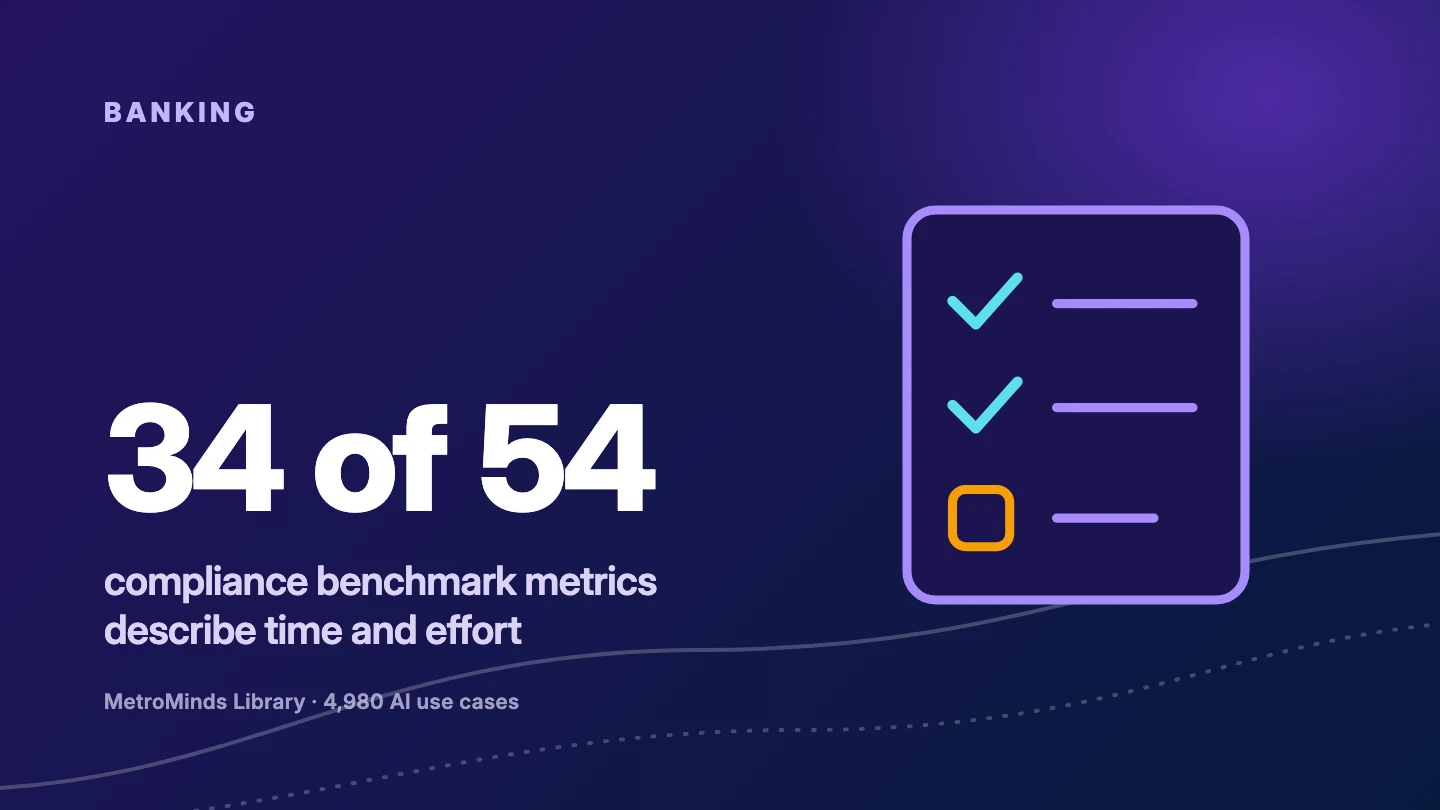
Each use case carries three benchmark metrics, so the 18 use cases have 54 metrics between them. Most of those metrics describe time and effort: 34 of the 54. Review time is the single most common benefit with 12 metrics, followed by handling time with 8. Another 16 metrics describe quality and rework, led by error and rework reduction with 11.

The pattern tells you where the time goes in compliance today. Most of it goes into preparing decisions rather than making them: opening alerts, finding the policy that applies, assembling evidence, checking whether a document is current, and redoing work when the first pass missed something. AI is good at that preparation, and compliance officers keep the decision.
That fits how international standard setters see technology in this field. The Financial Action Task Force has described the conditions under which new technologies "contribute to the efficiency and effectiveness of AML/CFT" [2]. Efficiency and effectiveness are both in that sentence for a reason. A tool that saves time but weakens the evidence trail is not an improvement.
The sweet spot: high value and easy to deliver
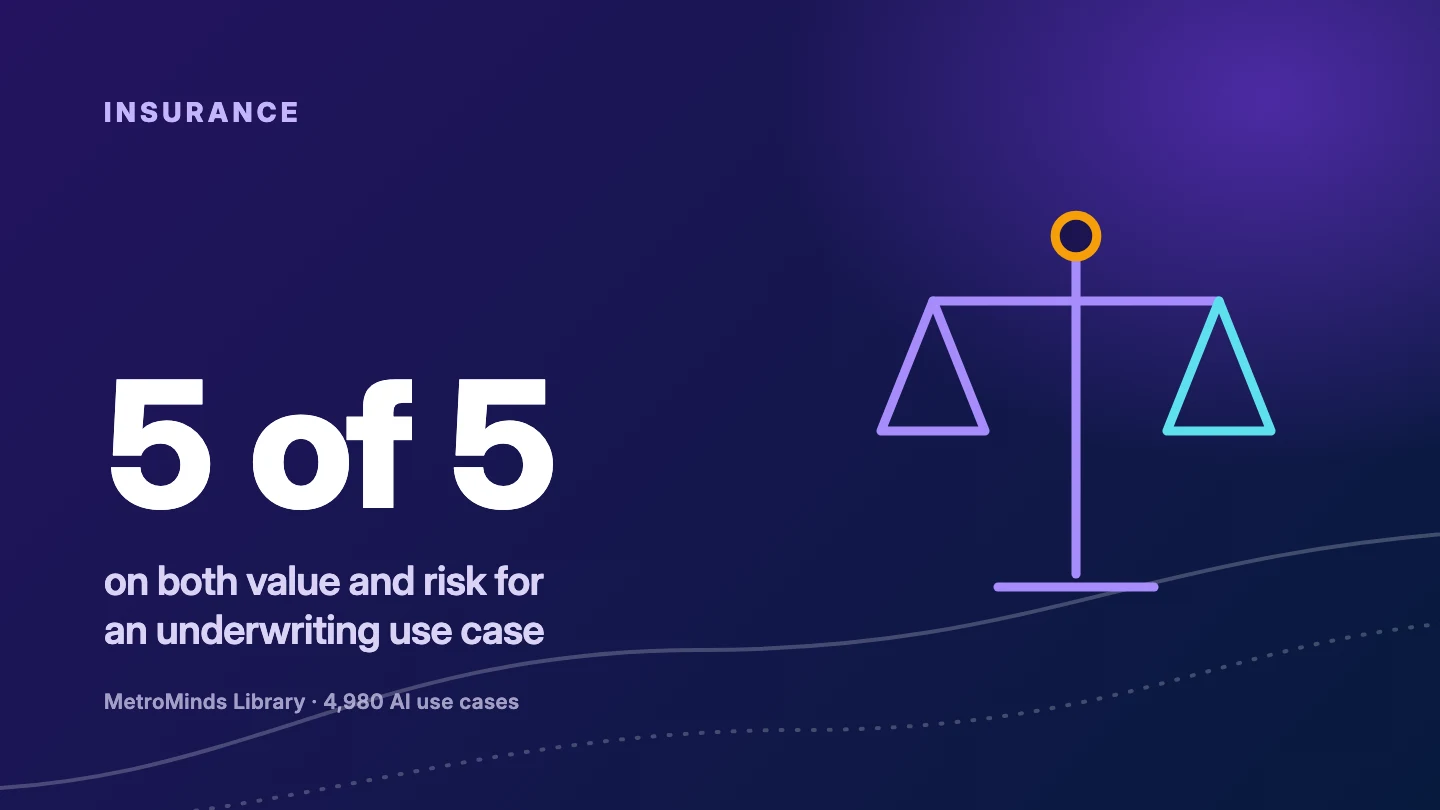
Not all 18 use cases are equally attractive. Six of them score 4 or 5 on both business value and feasibility. They include triaging sanctions screening alerts, telling a cluster of payment spikes apart from ordinary payday patterns, keeping commercial client files current for credit reviews, reconstructing the trail behind an automated recommendation, preparing grounded answers on hardship waivers and reviewing branch surveillance images in fraud matters.
What these six share is a clear, repeated workflow with a large volume of similar items, good access to the underlying records and a human who already makes the final call. The AI takes over the reading and sorting. The compliance officer keeps the judgement.
Regulatory change: the first idea is not always the best
Ask a compliance team where AI should help and many will name regulatory change first. A new rule arrives, and someone has to map it to policies, controls, products and customer files. It feels like the perfect job for a language model.
The Library is more nuanced. Three banking use cases sit in policy and regulatory mapping, and their scores vary widely. Reclassifying every onboarding document after a rule change scores only 1 out of 5 on business value. So does curating knowledge assets after a new circular. Preparing a grounded, source-backed answer for a hardship waiver decision scores 4. The difference lies in how often the work happens and how much of it a person still has to redo.
What the time saving is worth
Alert handling is a good place to put a number on compliance AI, because the volumes are known and the work is repetitive. The example below uses the benchmark from the sanctions screening use case above.
Keep resilience and evidence in the plan
Compliance AI runs inside a tightly regulated environment, and the business case should reflect that. Since 17 January 2025, the Digital Operational Resilience Act has applied to banks and other financial entities across the EU [1]. AI tools that become part of daily compliance processes are ICT services like any other, with requirements for resilience, incident handling and third-party risk.
The other requirement is evidence. Every use case in the sweet spot above keeps a traceable record of what the AI suggested and what the person decided. That trace is what lets compliance prove to an auditor or supervisor that control has not been weakened. When you compare options, a slightly smaller time saving with a better evidence trail is usually the better buy.
When you review compliance AI proposals, these checks are worth making.
- Where does our team spend its time today: preparing decisions, or making them?
- Which workflows have high volumes of similar items and good access to the records?
- Does the AI leave a trace of its suggestion and of the human decision?
- Is the tool covered by our DORA processes for ICT risk and third parties?
- Who decides how freed analyst time is used: investigations, growth or cost?
The question of how to value compliance and risk benefits in money is a topic of its own. Our article on building a credible AI business case in banking covers it.
How MetroMinds helps compliance teams choose
In MetroMinds you can filter the Library by industry, sector and capability to see the banking compliance use cases with their , value, feasibility and risk scores. Each use case describes the human decision point and the workforce impact, so you can see where the AI prepares work and where a person stays in control.
Before you commit, the AI Readiness Scan shows whether your data, governance and technology can support the use cases you have in mind, and where the gaps are.
How ready is your organisation for AI in compliance? Take the AI Readiness Snapshot
Sources
- EIOPA, "Digital Operational Resilience Act (DORA)", web page on Regulation (EU) 2022/2554, accessed October 2026.
- Financial Action Task Force, "Opportunities and Challenges of New Technologies for AML/CFT", July 2021.
- MetroMinds Library, 4,980 AI use cases with benchmark ranges based on real-world implementations, August 2026.