The camera pilot at an automotive supplier looked like a clear success. Mounted above the final inspection station, the AI quality control system spotted surface defects more reliably than the human inspectors, and it did so on every part, not on a sample. The quality manager was ready to order cameras for the remaining lines. Then someone asked a simple question in the steering committee: of all the defects the camera found, how many were contained before the parts left the plant?
Nobody knew. The camera raised an alert on a screen. What happened after that still depended on an operator noticing it, a team leader opening a hold in the quality system, an engineer deciding what to do with the lot, and someone writing the deviation report. The AI had made detection better. It had not touched the work that turns a detected defect into a contained one.
That is where many quality AI projects stall: between a promising pilot and a working quality process on the production line. The MetroMinds Library suggests that the biggest opportunities sit exactly in that gap.
Quality is the largest AI cluster in manufacturing
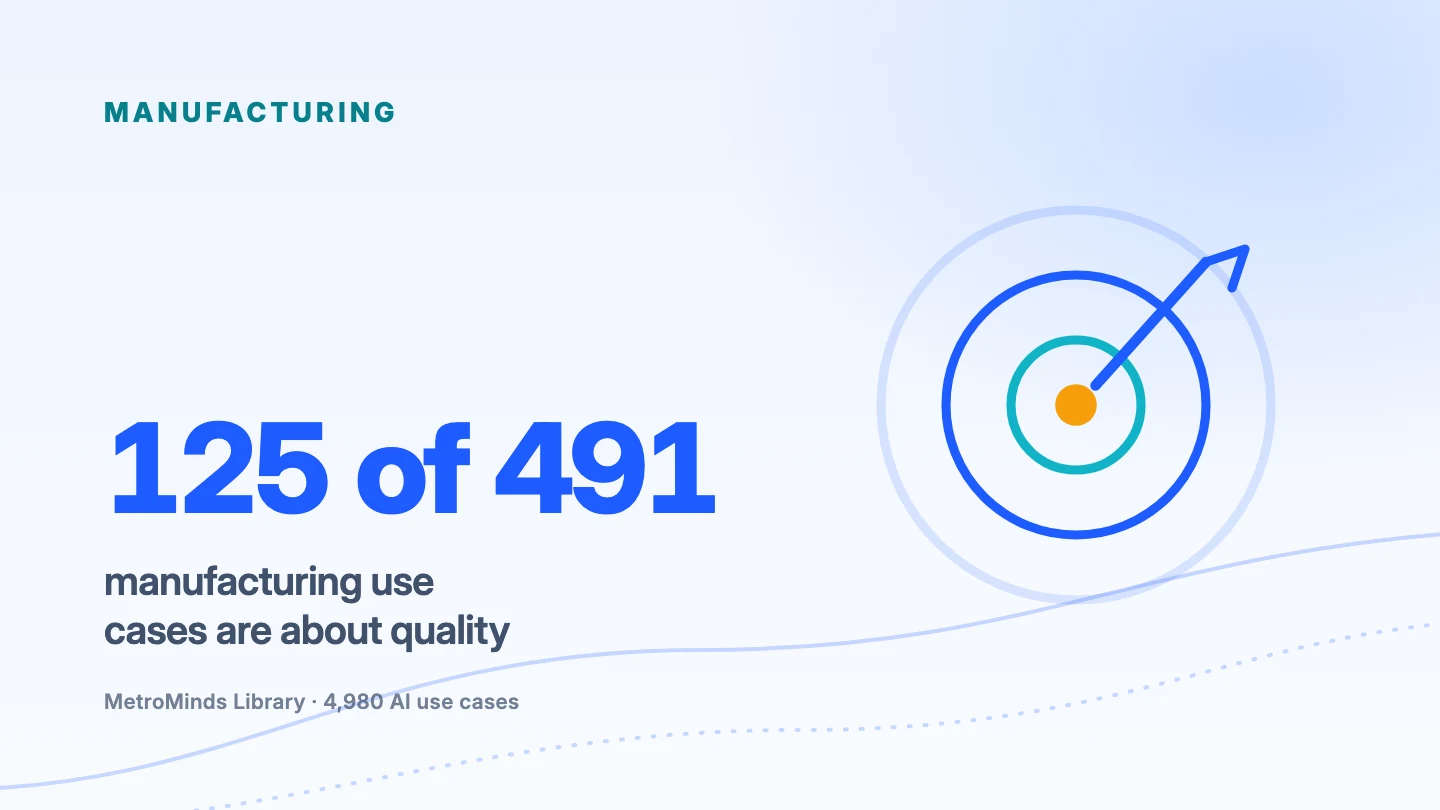
The Library holds 491 manufacturing use cases across six sectors, from automotive and aerospace to process and consumer goods manufacturing. A quarter of them, 125 in total, focus on four quality capabilities: nonconformance management (55), quality performance reporting (34), quality planning (20) and root cause analysis and corrective action (16). No other area of manufacturing comes close.
The spread across sectors is broad. Aerospace and defence manufacturing has the most quality use cases (30), followed by process manufacturing (28). Even the sectors with the fewest still count 16 each. Wherever products are made, the handling of defects and deviations absorbs a lot of skilled time.
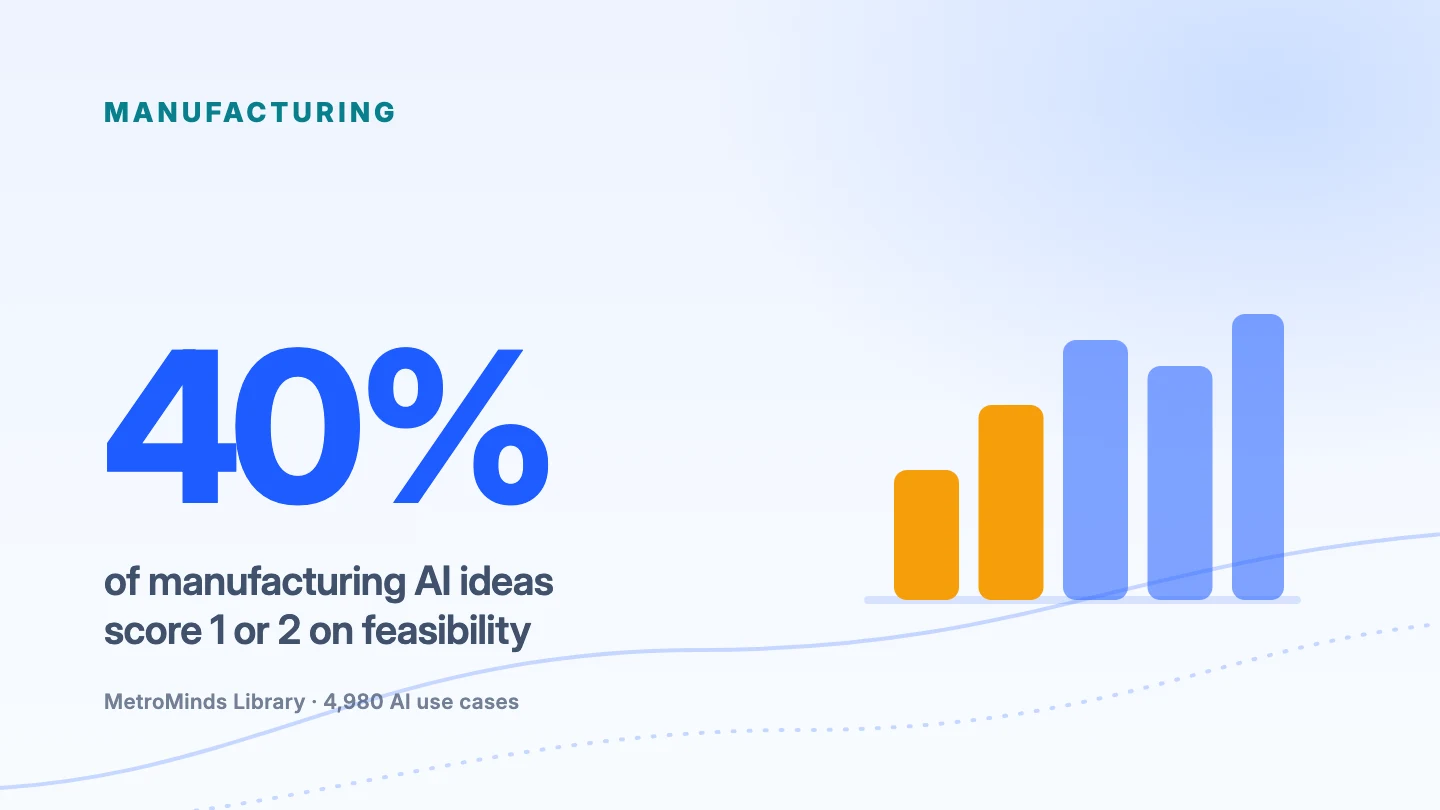
The quality use cases are also easier to deliver than the average manufacturing idea. Their feasibility score averages 3.62, against 3.05 for manufacturing as a whole, and the confidence in their is higher as well (4.50 against 4.29). That alone makes them worth a closer look when you choose where to start.
Most quality AI is not about cameras
When people picture AI quality control, they usually picture computer vision: a camera, a model and a red box around a scratch. In the Library, that kind of AI is a small part of the picture. Of the 125 quality use cases, only 10 belong to the perception domain, which covers vision, sound and sensor interpretation. That is 8 percent.

The other 92 percent work on what happens around and after the defect. Content discovery, the largest group with 36 use cases, helps engineers find the right specification, the earlier deviation on the same part or the procedure that applies. Agentic and augmentation use cases prepare holds and dispositions. Content creation drafts quality reports and operator briefings. Trust and governance use cases make sure an AI-supported quality decision can be traced and defended in an audit.
The benchmark ranges tell the same story. The most common metrics in these use cases are error and rework reduction, review time reduction and handling time reduction. They price the time of quality engineers and production managers, and the mistakes that happen when they work under pressure with scattered information.
Where the pilot stalls
A detection pilot can succeed without any of that. It runs on one station, someone watches the screen, and the results are measured against a manual sample. Scaling it to the production line is a different matter, because a defect only creates value once it is contained.
The American Society for Quality defines internal failure costs as costs "incurred to remedy defects discovered before the product or service is delivered to the customer", such as scrap and rework [1]. Detection moves a defect into that category instead of letting it reach the customer. But the cost of remedying it is still there, and it is mostly the cost of people working through holds, investigations, dispositions and reports.
The scenario below follows one defect from the camera to the corrective action, and shows where the time goes.
When a quality AI pilot stalls, it is usually because the next step was never designed. The alert does not open a hold, the hold does not link to the affected lots, and the engineer still searches for the last disposition on the same part by hand. The World Economic Forum noted in its 2023 Global Lighthouse Network report that leading manufacturers have moved past "pilot purgatory" and now focus on "overcoming the 'Scaling Slump'", meaning the work of extending capabilities across production networks and organisations [2]. For quality AI, scaling means connecting detection to the workflow that follows it.
What the hold workflow is worth
Because the value sits in the workflow, the business case should start there too. The example below uses the Library benchmark for the quality hold workflow and illustrative plant figures.
Questions for your next quality AI decision
- When the pilot detects a defect, what happens next, and who does it?
- Does an alert open a hold in the quality system automatically, linked to the affected lots?
- Which steps after detection take the most engineer time in your plant: scoping, disposition, investigation or reporting?
- Can every AI-supported disposition be traced back to its evidence in an audit?
- Is the business case built on engineer time first, with scrap and complaints as separate, evidenced benefits?
Detection still matters, and in some processes a camera is the right first step. But if your quality AI roadmap starts and ends with vision, you are looking at a small part of the opportunity. For the wider question of why manufacturing AI ideas are often harder than they seem, read our article on why four in ten manufacturing AI ideas are harder to deliver than they look.
Finding the quality use cases that matter
The MetroMinds Library lets you filter use cases by industry, sector, and , so a quality team can see all 125 manufacturing quality use cases side by side, not only the camera demos. Every use case is linked to a business capability from L1 to L3, which makes it easy to see which ones support the same quality workflow and should be planned together.
In the portfolio, each use case gets a business case with low, mid and high benchmark ranges and explicit scope, adoption and . The value and feasibility matrix then shows which quality ideas belong in and which need more preparation.
Want to see the full set of quality use cases for your sector? Book a demo
Sources
- ASQ (American Society for Quality), "What is Cost of Quality (COQ)?", quality resources.
- World Economic Forum, "Global Lighthouse Network: Adopting AI at Speed and Scale", 14 December 2023.
- MetroMinds Library, 4,980 AI use cases with benchmark ranges based on real-world implementations, August 2026.