The steering committee of a mid-sized insurer is reviewing three AI proposals for its claims department. The first is an assistant that helps claims handlers check policy wording. The second reads incoming documents and pre-fills the claim file. The third is an agentic workflow that plans the next steps on complex claims. Each comes with a carefully prepared AI business case, and each promises to cut claims handling time by 20 to 30 percent.
Approve all three and, on paper, the claims department saves well over half of its handling time. Nobody in the room really believes that number, but nobody can say exactly what is wrong with it either. The explanation is simple: the three business cases are counting the same minutes of the same people.
This is one of the most common errors in AI portfolios, and one of the easiest to miss, because every individual business case can be perfectly sound. The problem only appears when you add them up. In this guide we look at why it happens so often, what it looks like in real data from the MetroMinds Library, and how you can correct the total before it reaches your CFO.
Why AI business cases overlap so often
Most AI use cases promise the same kind of benefit: work gets done faster. In the MetroMinds Library, which holds 4,980 AI use cases across 13 industries, 99 percent have a time or effort saving as their headline benefit. Handling time reduction appears in 57 percent of all use cases and review time reduction in 53 percent.
That is not a flaw in the use cases. Faster handling is simply the most direct and measurable effect of most AI applications. But it creates a structural risk for your portfolio. If ten initiatives all claim a share of the same employee's working week, the combined claim can easily exceed the week itself.
The risk starts even before the portfolio discussion. Three out of four use cases in the Library (74 percent) carry two or more time-based metrics, such as handling time and review time. Inside a single business case, those two often describe the same minutes from different angles. If you count both, you have double counted within one proposal.
Gartner has pointed at the underlying difficulty. In its 2024 prediction that at least 30 percent of generative AI projects would be abandoned after proof of concept, it named unclear business value as one of the causes, and noted that productivity gains "can be difficult to directly translate into financial benefit" [1]. When overlapping benefits are added together, that translation gets harder still, because the starting number is already too high.
What double counting looks like in real data
To make this concrete, we looked at one capability in one industry: case and exception handling in financial services. The Library holds 44 use cases for this capability, spread across 10 different , from conversational AI to document understanding and agentic AI. Twenty-four of them are in insurance.
Seventeen of those insurance use cases focus on claims. Each comes with a for handling time reduction, based on real-world implementations. Taken one by one, the ranges look reasonable: somewhere between 10 and 45 percent, with most midpoints around 25 percent.
Now take only the six use cases that support the work of the claims handler. They help with checking an exclusion, testing policy wording, confirming which next steps need a signature, settling a coverage question, answering policyholder concerns and tracing which wording applied in a dispute. If you add up their midpoint handling time reductions, you arrive at 147.5 percent of the claims handler's handling time.

No claims handler can save more time than they spend. Yet each of these six business cases, read on its own, is defensible. Repeat the exercise across all seventeen claims use cases and the midpoints add up to more than 400 percent.
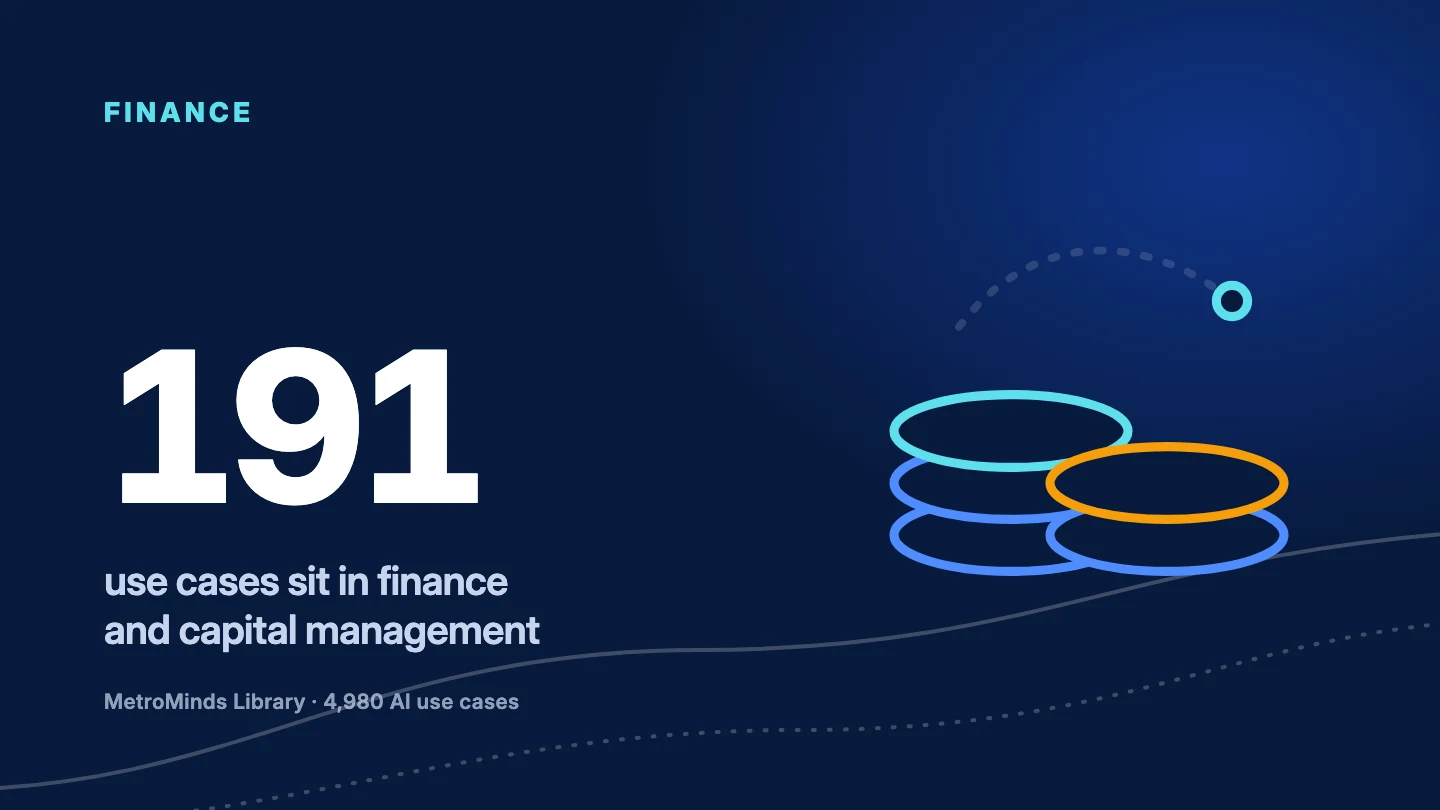
The pattern is not limited to insurance. In government, the Library holds 77 use cases for case and exception handling alone, again coming from 10 AI domains. In energy and utilities, 66 use cases target asset reliability and compliance. Across the whole Library there are 36 combinations of industry and capability with 20 or more use cases each. Wherever that many ideas meet the same piece of work, overlap is close to guaranteed.
Four places where the same saving hides
Double counting rarely looks like double counting. In our experience it hides in four places, and each needs a slightly different check.
The same role, the same clock
This is the claims handler example. Several use cases support different tasks of the same role, but their savings are all expressed as a share of total handling time. The fix is to express each saving in minutes for the specific task it supports. Then check that those tasks together do not add up to more than the time the role actually spends on them.
The same capability, different types of AI
A chatbot, a document reader and an agent can all target the same process. Because they come from different teams or vendors, and carry different , nobody notices that they compete for the same pool of savings. Linking every use case to a makes this visible. If five initiatives sit on the same capability, you assess them together rather than one by one.
Two metrics for one benefit
Handling time, review time and rework reduction often describe the same improvement. A claim that is handled correctly the first time needs less review and less rework later. Adding all three to one business case inflates it. Choose one headline metric and use the others as evidence that the headline benefit is real.
The same hours, turned into money twice
Saved time can become money in different ways: the team handles more volume, the organisation avoids new hires, or headcount goes down. One business case may claim capacity release while another claims avoided hiring for the same team. Finance should decide which route applies to each team, and apply it once.
Agents make the overlap harder to see
Agentic AI deserves a separate mention. In the financial services example, agentic use cases form the largest group: 13 of the 44 use cases for case and exception handling. Across the Library there are 600 agentic use cases.
Agents tend to work across a whole workflow rather than one task. A claims settlement agent plans steps, gathers documents and prepares decisions from start to finish. Its business case therefore claims a saving on the entire workflow, while assistants for individual tasks claim savings on parts of that same workflow. Both can be correct on their own and still overlap almost completely.
So whenever an agentic use case enters the portfolio, check which task-level initiatives already target the same workflow. Either the agent replaces them, or their savings shrink once the agent is live. In both cases, the portfolio total should not include both at full value.
Why adding up savings is the wrong maths
Even when two initiatives really improve different parts of a task, their effects do not simply add up. The second improvement works on the time that is left after the first one, not on the original baseline.
Take the six claims handler use cases again. If each one delivered its midpoint saving on the remaining time, one after the other, the combined effect would be about 82 percent instead of 147.5 percent. That is still far too optimistic, because it assumes every initiative touches every claim and is fully adopted.

Realistic business cases also apply a , which reflects the share of the work that the initiative affects, and an , which reflects how much of it people actually use. Once those are included, the realistic combined number is usually much closer to the strongest single case than to the sum.
That is why the business case templates in the MetroMinds Library all follow the same structure. They start from annual volume and baseline minutes per item, apply the benchmark reduction and the fully loaded hourly cost, and then correct for scope, adoption and confidence. Each of those factors is a natural point where an overlapping initiative should lower the number.
What the difference means in euros
Percentages can feel abstract, so we put the claims handler example into money. The box below walks through the calculation with illustrative assumptions.
The gap changes the decision itself. At 818,000 euros a year, funding all six initiatives looks like an easy choice. At 393,000 euros, with six implementations to build, integrate and support, you may decide to fund two or three and stop the rest. That is exactly the kind of choice a portfolio should help you make.
How to correct the total, step by step
You do not need a complex model to correct double counting. You need a few rules that every business case in the portfolio follows.
- Link each use case to a business capability and to the role whose work changes. That gives you the groups of initiatives that share a pool of savings.
- Choose one headline metric for each piece of work. If handling time is the headline, review time and rework become supporting evidence rather than extra euros.
- Agree an for initiatives on the same capability. A use case that adds a modest improvement on top of a stronger one might count for a third or half of its standalone value.
- Ask finance to fix the monetisation route for each team: capacity release, avoided hiring or cost reduction. One route per team, per year.
- Recalculate the total and compare it with the baseline. If the portfolio claims more time than the affected roles have available, something is still counted twice.
Public sector benefits frameworks have warned about this for years. The New South Wales Government's benefits realisation framework puts it plainly: "Double counting of benefits impacts the ability of senior management to make informed decisions." [3] The same is true for AI. An inflated total leads to the wrong choices about which initiatives to fund, and it makes results look disappointing later, even when the initiatives themselves work well.
It also costs trust. In McKinsey's State of AI 2026, only 37 percent of respondents attribute any EBIT impact to AI, and just 6 percent qualify as high performers [2]. When portfolios promise far more than that, finance learns to discount every AI business case, including the good ones.
Questions to ask before your next steering committee
- Which use cases in our portfolio support the same capability or the same role?
- For each of those groups, does the combined saving exceed the time the role actually spends on that work?
- Does any single business case count handling time, review time and rework as separate benefits?
- Which monetisation route has finance agreed for each team, and is any team counted under two routes?
- Is there an agentic use case that covers a workflow where task-level assistants are already planned?
- If we fund only the strongest initiative in each group, how much of the total value do we keep?
The last question is often the most revealing. In many portfolios, one or two initiatives per capability deliver most of the value, while the rest mainly add complexity.
How MetroMinds helps you count each saving once
MetroMinds was built with this problem in mind. Every use case in the Library is linked to a business capability from L1 to L3 and describes the role whose work changes. Of the 14,940 benchmark metrics in the Library, 13,500 come with an explicit double counting warning, so you can see straight away which benefits cannot be combined.
In the portfolio business case, MetroMinds shows overlap by L3 capability, flags the overlap risk and recommends correction weights for initiatives that compete for the same savings. You can adjust those weights yourself and watch the portfolio total change. That way, the number you take to the board is one you can defend, before any use case moves from accepted to approved for execution.
For the wider question of which initiatives deserve funding at all, read our earlier article, The hardest AI decision isn't what to start. More on how we approach AI value is on our value realisation page.
Want to see overlap correction on your own AI portfolio? Book a demo
Sources
- Gartner, "Gartner Predicts 30% of Generative AI Projects Will Be Abandoned After Proof of Concept By End of 2025", press release, 29 July 2024.
- McKinsey & Company, "The state of AI in 2026: On the road to ROI", 25 August 2026.
- NSW Government, Department of Finance, Services and Innovation, "Benefits Realisation Management Framework, Part 1: Principles", 2018.
- MetroMinds Library, 4,980 AI use cases with benchmark ranges based on real-world implementations, August 2026.