The treasurer of a mid-sized retail bank presents three AI proposals to the asset and liability committee. One forecasts deposit runoff under a rate shock, one sizes branch cash buffers for payroll weeks, and one ranks borrowers who are starting to slip into late payment. The risk team describes the benefits in its own language: fewer surprises, smaller losses, better limits. Then the CFO asks the question every AI business case in banking eventually meets. Which line in the profit and loss account will actually move, and how will we know?
That question is harder to answer than it looks. The MetroMinds Library shows that the benefits of banking AI in risk and finance are spread across many different routes to value, and that the route the risk function cares about most is the one with the least evidence behind it.
Twelve banking use cases, nine routes to value
The Library holds 81 use cases for banking. Twelve of them sit in finance and risk: treasury and payments, financial risk management, cash flow planning and capital allocation. Each use case comes with three benchmark metrics, so together they carry 36 metrics. Each metric has a default monetisation path, the route by which the benefit is turned into money in a business case.
Those 36 metrics use eight different routes, and three metrics have no route yet. Time saved per item is the most common, with 14 metrics. Rework cost avoided and quality improvement follow with five each, then effort per FTE with four. Only one metric is priced as a loss the bank avoids.

The same pattern holds across the whole Library. Of 14,940 benchmark metrics, 200 are priced as risk loss avoided, which is 1.3 percent. In banking it is 4 out of 243. The reason is not that AI cannot reduce losses. It is that a loss avoided is much harder to measure than a minute saved, so the comparable evidence is thinner.
Why loss avoidance tempts banks
For a risk function, loss avoidance is the natural way to think about value. A better early warning on late payments means fewer defaults. A sharper view of cash buffers means fewer emergency transports or idle cash. Those benefits can be large, and in a single bad quarter they can dwarf any time saving.
The problem is the counterfactual. To claim a loss avoided, you have to show what would have happened without the AI, in a world where rates, customers and markets keep changing. That makes loss avoidance easy to promise and hard to prove. A business case built mainly on it will struggle in front of a CFO who wants a measurable baseline, and later in front of an auditor who wants evidence that the benefit arrived.
That is why the Library treats loss avoidance as one route among several, and why most banking use cases rely on routes with a clearer baseline: the time spent per review, the rate of rework, or the number of items that pass straight through.
It also explains why almost every use case combines routes. Eleven of the twelve use cases mix at least two routes to value; the twelfth has no route defined yet. A business case that picks only the most attractive route, and ignores the others, gives a distorted picture in both directions.

Regulation is part of the cost, not only the risk
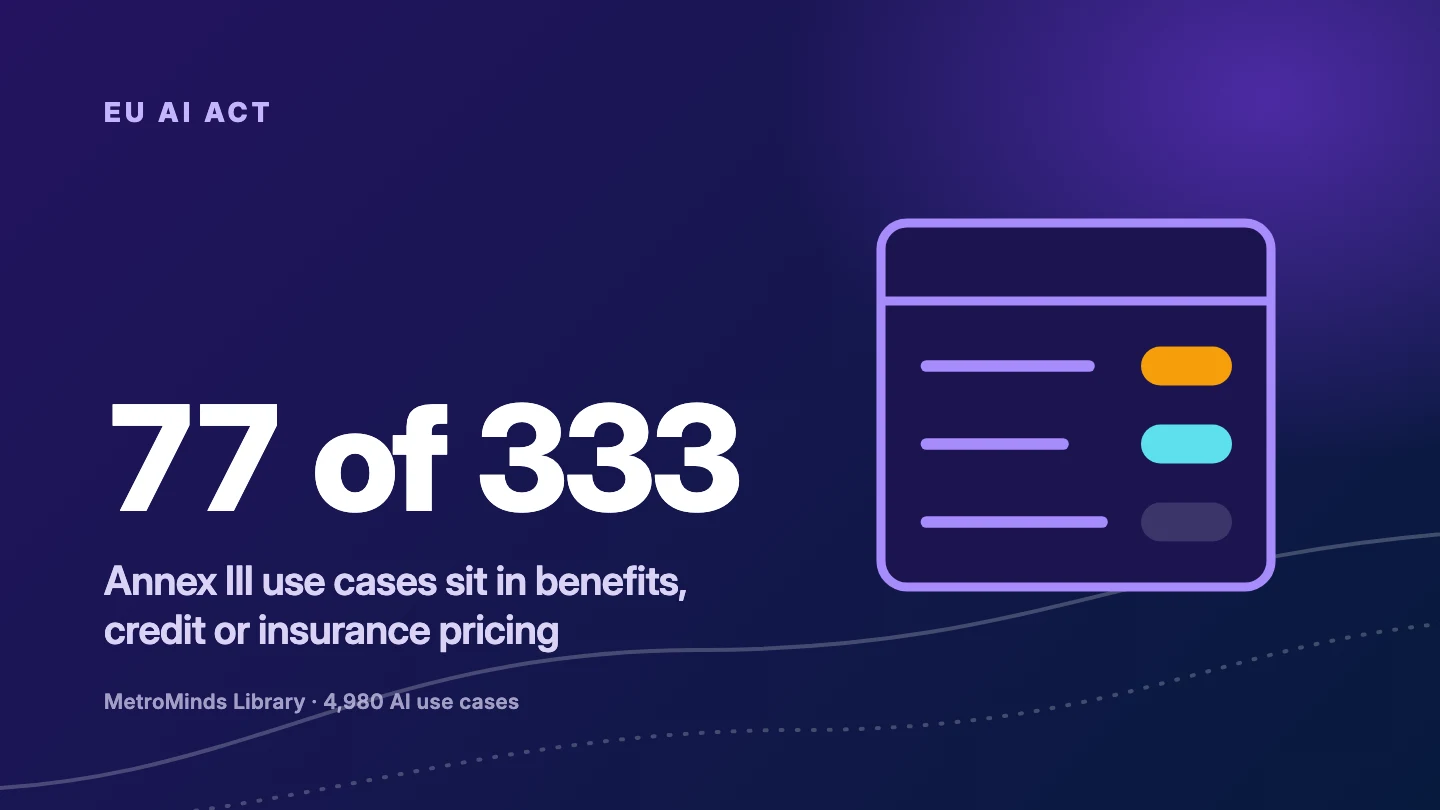
Banking AI also carries governance costs that business cases often leave out. Under the EU AI Act, AI systems used to evaluate the creditworthiness or credit score of natural persons "should be classified as high-risk" [2]. The same recital makes an exception: AI systems provided for by Union law to detect fraud in financial services "should not be considered to be high-risk" [2]. Which side of that line a use case falls on changes the documentation, testing and oversight it needs.
Supervisors look beyond the AI Act as well. In its 2023 follow-up report on machine learning in internal ratings-based models, the European Banking Authority reiterated recommendations "aiming at ensuring a prudent use of machine learning models" and noted that machine learning in credit risk models "may create issues beyond the scope of prudential consideration" [1]. For a business case, that means model validation, explainability and monitoring are recurring costs, not a one-off project task.
The twelve finance and risk use cases in the Library are, on the whole, sensible candidates. Their average feasibility score is 3.67, above the banking average of 3.47, and their average confidence score is 4.33. Their risk score averages 3.58, lower than banking as a whole at 3.80. They are not the riskiest AI in a bank. But they still sit close to decisions about money, so the governance line in the business case deserves real numbers.
Putting a number on avoided losses
When a use case does reduce losses, it is worth pricing that benefit carefully rather than leaving it out. The calculation is simple. The work lies in agreeing the inputs.
Five questions for a banking AI business case
Before a risk or finance use case moves forward, these questions help the CFO, the business owner and the risk function agree on what is being promised.
- Which route does each benefit take: time, rework, quality, throughput or loss avoided?
- For each route, what baseline do we have today, and who owns the data?
- Are any benefits counted twice, for example review time and handling time on the same work?
- Does the use case touch creditworthiness or credit scoring of natural persons, and if so, are the AI Act obligations and their costs in the plan?
- Which model validation and monitoring costs recur every year, and who carries them?
Compliance use cases raise a related set of questions about where AI really saves time. Our article on AI in banking compliance looks at that side of the bank.
How MetroMinds helps banks build the case
In MetroMinds, every benchmark comes with its monetisation route and the inputs that route needs, so the business case shows clearly which benefits rest on time, which on rework and which on avoided losses. Scope, adoption and confidence factors are explicit, and overlapping benefits on the same work are flagged rather than added up.
Each use case also carries a risk score next to its value and feasibility, so the governance effort is visible from the start. That gives the CFO, the risk committee and the business owner one shared view of what the bank is buying and what it will have to prove.
Want to see how your risk and finance AI proposals would score? Book a demo
Sources
- European Banking Authority, "The EBA publishes follow-up Report on the use of machine learning for internal ratings-based models", 4 August 2023.
- Regulation (EU) 2024/1689 (Artificial Intelligence Act), Recital 58.
- MetroMinds Library, 4,980 AI use cases with benchmark ranges based on real-world implementations, August 2026.