The operations director of an electronics manufacturer has a shortlist of twenty AI ideas on the table. The ones that excite the management team most are easy to spot: a system that maps the whole supplier network and warns when a single failure could stop several product lines, an optimiser that reshuffles production when a component shortage hits, an agent that coordinates recovery after a machine breakdown. Further down the list sit less exciting ideas, such as searching old deviation reports and drafting quality summaries.
Six months later, the exciting ideas are stuck in design workshops, while two of the dull ones are already in daily use. Nobody planned it that way. It is simply what happens when you choose AI in manufacturing on the size of the promise without looking hard at how difficult the idea is to deliver.
The MetroMinds Library makes that difficulty measurable. And the numbers show that the pattern is not bad luck: it is built into the kind of ideas that appeal to manufacturers most.
Four in ten manufacturing AI ideas are hard to deliver
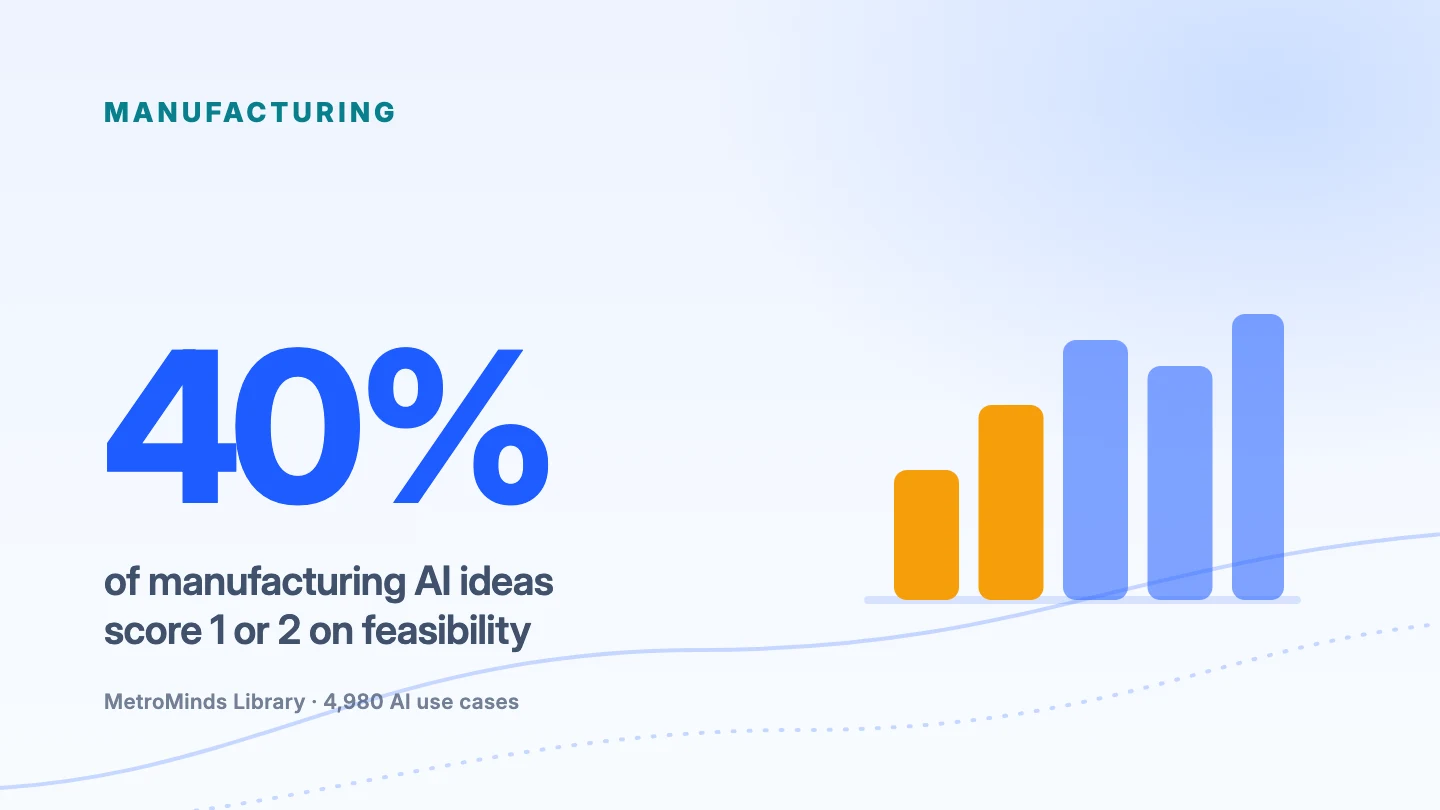
Every use case in the Library has a feasibility score from 1 (hard to deliver) to 5 (easy to deliver). Of the 491 manufacturing use cases, 196 score 1 or 2. That is 40 percent, against 27 percent for the Library as a whole.

The low-feasibility ideas are not the weak ones. Two thirds of them (130 of 196) score 4 or 5 on business value, almost the same share as among the easy ideas. On average, they even score slightly higher on value (3.74 against 3.42 for ideas with feasibility 4 or 5). That is exactly what makes them attractive in a workshop and dangerous in a portfolio.
It is not about your sector
A common reaction is that this must depend on the type of manufacturing. Aerospace has strict certification rules, process plants run continuous operations, consumer goods companies change products constantly. Surely some sectors find AI easier than others?
The Library says no. In all six manufacturing sectors, between 38 and 41 percent of use cases score 1 or 2 on feasibility. Automotive is at 41 percent, aerospace and defence at 40 percent, industrial manufacturing at 38 percent, and electronics, process and consumer goods manufacturing each at 40 percent.

So the difficulty does not come from the industry. It comes from the type of work that the AI is asked to support, and that work looks remarkably similar across factories.
Hard ideas have better data and harder decisions
The most surprising finding is what does not explain low feasibility. You might expect the hard ideas to suffer from poor data or weak integration. The opposite is true. Manufacturing use cases with a feasibility score of 1 have an average data access score of 4.65 and an integration readiness of 4.45. The easiest ideas, with a feasibility score of 5, score lower on both: 3.49 and 3.29.
What separates them is the decision. Decision complexity averages 3.88 for the hardest ideas and 2.34 for the easiest. Orchestration complexity runs from 4.16 down to 2.49. The risk score, which reflects how costly a wrong outcome would be, falls from 4.63 to 2.34. The hard ideas sit where a mistake stops a line, affects a customer or creates a safety issue.

The types of AI involved confirm this. The 196 hard ideas are dominated by agentic AI, decision intelligence and prediction (30 use cases each), followed by optimisation (24) and simulation (21). The easiest group is led by content discovery (43 use cases), trust and governance (25) and content creation (24). Finding, checking and drafting are easier to deliver than deciding and acting.
Two ideas with the same promise
The difference becomes concrete when you put two real use cases from the Library next to each other. Both deal with supplier risk in automotive manufacturing, and both are worth funding. Only one of them is easy to deliver.
Why manufacturers keep picking the hard ones first
The attraction of the hard ideas is understandable. They are closest to the factory floor, they promise the most visible results, and they make the best presentations. Meanwhile, AI use in European companies still focuses elsewhere. Eurostat reports that in 2025, among manufacturing enterprises using AI, the most common purposes were marketing and sales (30.41 percent) and business administration or management (27.05 percent) [1].
The same Eurostat data shows what holds companies back. Among enterprises that considered AI but did not use it, 70.89 percent named a lack of relevant expertise as a reason [1]. The skills needed for the hard manufacturing ideas, such as defining decision rights, designing human review and handling exceptions, are exactly the ones that are scarce.
The manufacturers that do scale AI tend to treat it as a people and operating model question. McKinsey's analysis of the Global Lighthouse Network puts it simply: "Transformation approaches at Lighthouses are deeply rooted in people" [2]. That matches the Library: the hard part of the hard ideas is the decision, and decisions belong to people.
How to use feasibility in your portfolio
- Score every idea on feasibility as well as value before the shortlist is final, and keep the two scores visible together.
- Do not read high data readiness as a sign that an idea is easy. Check decision complexity, risk and the number of teams involved.
- Balance the portfolio: combine one or two strategic bets with several easier ideas that build skills, trust and evidence.
- For each hard idea, name the owner of every decision the AI supports, and the conditions under which a specialist must step in.
- Expect the easier ideas in finding, checking and drafting to deliver first, and use their results to fund the harder ones.
For one example of a high-value area where feasibility is the main obstacle, see our article on why predictive maintenance pilots rarely make it to the factory floor.
Balancing value and feasibility with MetroMinds
In MetroMinds, every use case comes with a business value and a feasibility score, and the portfolio matrix places them in four quadrants: , Strategic bets, Quick improvements and Park / rethink. The , and profiles show why an idea lands where it does, so you can tell a data problem from a decision problem.
The AI Readiness Scan then compares what your portfolio demands with what your organisation can deliver today. For manufacturers with a list full of strategic bets, that comparison is often the most useful conversation the management team can have.
How ready is your organisation for the AI ideas on your shortlist? Take the AI Readiness Snapshot
Sources
- Eurostat, "Use of artificial intelligence in enterprises", Statistics Explained, data extracted December 2025.
- McKinsey & Company, "Lessons from the Lighthouses", 21 February 2025.
- MetroMinds Library, 4,980 AI use cases with benchmark ranges based on real-world implementations, August 2026.