A new head of claims transformation at a property and casualty insurer starts in September. In her first week she receives a spreadsheet from her predecessor: every AI idea that teams, vendors and consultants have proposed for the claims department over the past year. It has 31 rows. Some are pilots, some are slides, and a few are already running in one region without anyone quite knowing who approved them. Every row is about AI in claims handling.
Her first question is a fair one: which of these should we actually do? Everything on the list targets claims, everything promises faster handling or happier policyholders, and every sponsor believes their idea is the obvious first step. Claims has a choice problem more than an idea problem.
Claims is the most crowded part of insurance AI
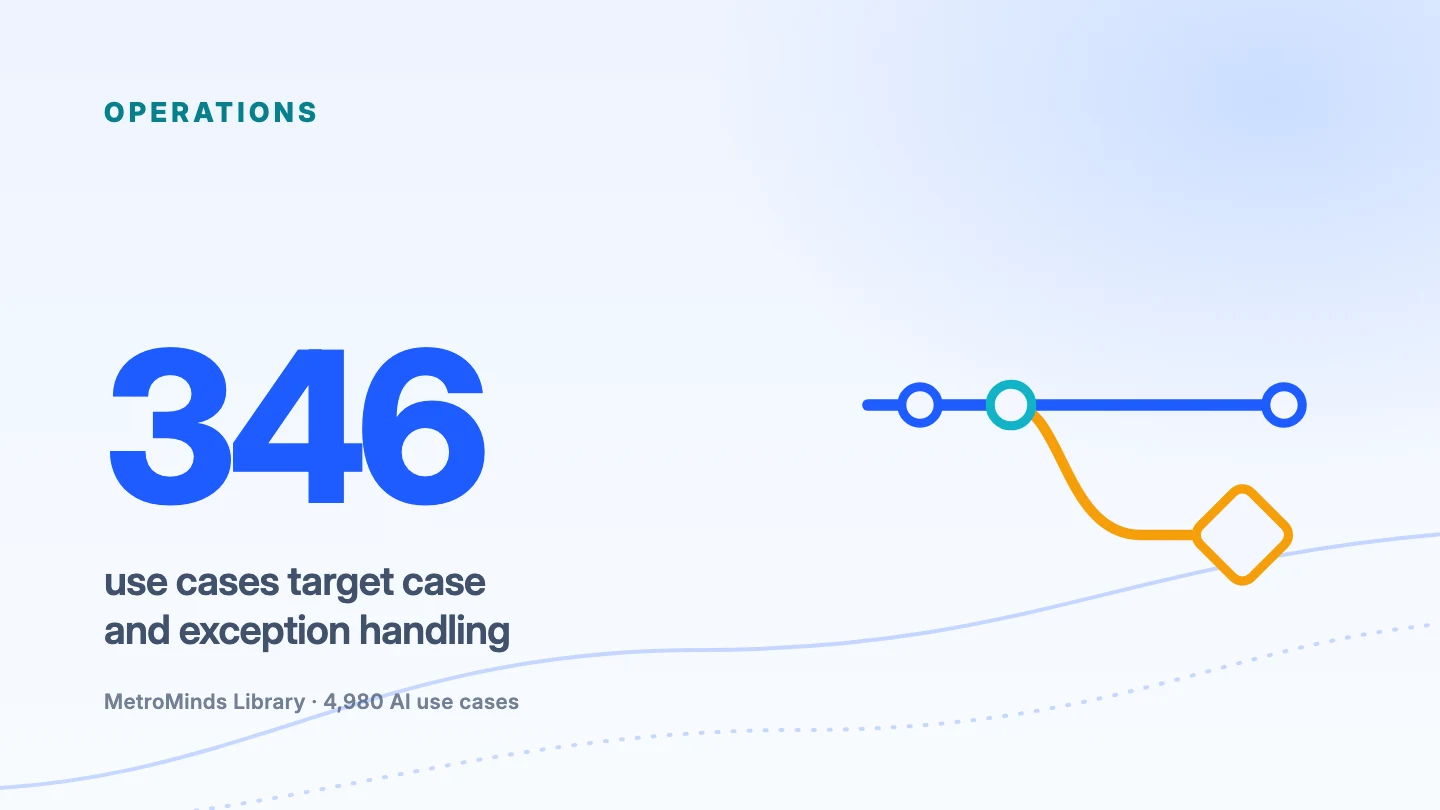
The MetroMinds Library holds 84 use cases for insurers. Of those, 24 sit on a single : case and exception handling, the daily work of moving claims from notification to settlement. That is 29 percent of all insurance use cases on one capability. The next largest, risk identification and assessment, has nine.
The concentration makes sense. Claims is where most of an insurer's people work, where policyholders feel the service, and where documents, phone calls and judgement calls pile up. It is also where vendors focus, because the problems are easy to recognise. The European insurance supervisor EIOPA found in 2024 that artificial intelligence was already used by 50 percent of the respondents in non-life insurance and 24 percent in life insurance [1].
A crowded capability is not a bad thing in itself. It means there are many credible ways to improve the work. But it does move the difficult work from finding ideas to choosing three or four that fit together, and saying no to the rest without losing the people who proposed them.
Ten different kinds of AI for the same work
The 24 claims use cases are not variations of one tool. They come from ten different . Seven are agentic, where AI plans and coordinates steps across systems. Four are augmentation, where AI supports a claims handler's judgement while they work. Three are about finding and reading information, two use conversational AI, two use perception such as speech or images, and two create content such as policyholder letters.

This variety matters for the decision. Ideas from different domains are usually proposed by different people. The contact centre manager suggests a voice assistant, the claims operations team suggests an orchestration agent, and the communications team wants help drafting letters. Each is assessed in its own meeting with its own vendor. Nobody puts them side by side, so nobody sees that they all compete for the same claims budget, the same integration team and the same handlers' attention.
Value and feasibility tell very different stories
Every use case in the Library carries a business value score and a feasibility score on a scale of one to five. When you plot the 24 claims use cases on those two axes, the choice becomes much clearer than it is in a ranked list.

Eight use cases combine high value with high feasibility. In the MetroMinds portfolio matrix these are the "" candidates. Many of them are less glamorous than you might expect: retrieving damage findings for an adjuster, turning a claim decision into a clear letter, coordinating repair steps across systems. They work on well-defined tasks with data that is already available.
Nine use cases have high value but lower feasibility. These are the strategic bets, and four of the seven agentic ideas sit here: reading an exclusion on an injury file, running the full settlement workflow and confirming which next steps need a signature. The optimisation idea for resequencing adjuster visits after a hail catastrophe is here as well. They can be worth a lot, but they depend on integration, data access and controls that many insurers still need to build. Three use cases are easy to deliver but add limited value, and four score low on both.
A list ranked by value alone would put the strategic bets on top and push feasible wins down. The two axes together suggest a first wave from the top right, with one or two strategic bets prepared in parallel.
Turning a long list into a decision
A matrix helps you see the options, but it does not make the decision for you. What helps is a simple, visible process that every claims idea goes through. In MetroMinds that process uses a small set of statuses. Every idea starts as a candidate. After a first assessment, a portfolio manager either accepts it into the portfolio, puts it on hold or rejects it, and a hold or a rejection always needs a written reason. Accepted ideas are compared with each other, and the ones that will be funded move to and then in execution.
The written reason is more useful than it sounds. When the contact centre manager asks six months later why the voice assistant was put on hold, the answer is in the portfolio rather than in someone's memory. It also makes it easier to bring an idea back when the reason no longer applies, for example once a data platform is in place.
What usually goes wrong
Three patterns come up again and again when insurers choose their claims AI. The first is choosing by vendor demo. A strong demo shows what is possible under good conditions and says little about your own data, systems and volumes. Treat it as one input.
The second is spreading the budget too thin. Funding a small pilot for every idea keeps everyone happy for a quarter and produces nothing that scales. It is usually better to fund three ideas properly, with integration and change management included, than to fund ten halfway.
The third is ignoring how ideas overlap. Several claims ideas often promise savings on the same work of the same handlers. If you add those savings up, the total will look better than reality. We wrote about this separately in our article on double counted savings, and it is worth checking before the final selection.
It also helps to look at where the market is heading. In early 2026, EIOPA reported that nearly two-thirds of the insurers it surveyed were already actively using generative AI, and that 64 percent of the reported use cases targeted back-end productivity tools such as data extraction and content generation [2]. In claims, that means most of your competitors are working on the same type of ideas you are. The difference will come from how well you choose and how quickly you scale the few that work.
Questions for your next claims portfolio review
- Are all claims AI ideas in one portfolio, including the ones running quietly in one region?
- Has every idea been scored on value and feasibility in the same way, by the same people?
- Which claims steps are covered by the ideas you plan to fund, and which steps have three ideas competing?
- For every idea on hold, is the reason written down, together with what would release it?
- Which strategic bet are you preparing now, so that it is feasible by the time the first wave is live?
How MetroMinds helps insurers choose
MetroMinds gives claims leaders one portfolio for every AI idea, scored on the same criteria and plotted on the value and feasibility matrix. You can start from the Library, which holds 24 claims use cases for insurers with based on real-world implementations, and add your own ideas next to them. Statuses and written reasons make every decision traceable, from candidate to approved for execution.
Want to see your claims ideas on the matrix? Book a demo
Sources
- EIOPA, "EIOPA report takes the pulse of digitalisation in the European insurance market", 30 April 2024.
- EIOPA, "EIOPA survey on Generative AI shows swift but cautious adoption among Europe's insurers", 2 February 2026.
- MetroMinds Library, 4,980 AI use cases with benchmark ranges based on real-world implementations, August 2026.